depeperwinkel
Za'atar
Za'atar
In stock
Unable to load availability for pickup
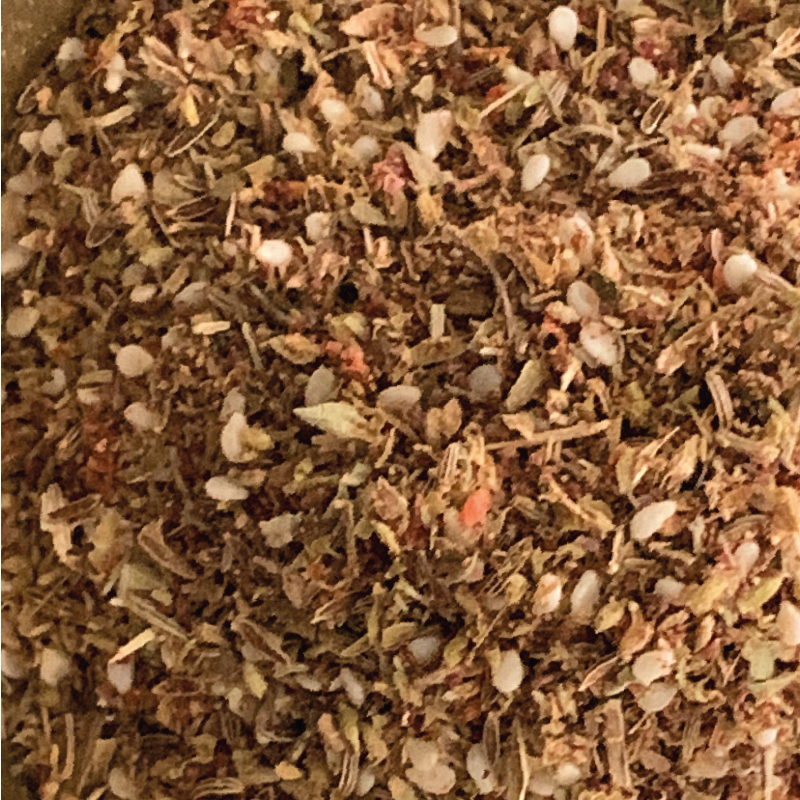
Za'atar, named after the traditional main ingredient, Syrian marjoram, is a spice blend made from green herbs, sumac, and sesame seeds. The original blend is said to have been merely a combination of Syrian oregano ( Origanum syriacum) sesame seeds and salt.
This mixture will soon be discontinued from our range!
The word za'atar is not only the name of the mixture, but also of a group of herbs: savory, wild basil-thyme, thyme, and the herbs of the oregano genus, including marjoram and oregano. It is therefore not surprising that many za'atars nowadays contain oregano, thyme and common marjoram, all three after all za'atars.
In the Middle Ages, za'atar (with sumac) was used as a medicine, as was the case with many herbs, spices, and mixtures. It was used, for example, for colds.
Za'atar is often given its own unique signature and is therefore available on the market in every conceivable variation. 'Green za'atar' comes closest to the original recipe, but usually too little sesame seed is added to it, leaving the flavor somewhat bland; the ratio of herbs to sesame should be approximately 4:1. Sumac is added to 'red' za'atar, just as in medieval medicine. Our za'atar is of this latter type, but contains no salt. The advantage of this is that adding za'atar does not affect the salt content of the dish, which you can season with salt to your liking.
Za'atar, like bahārāt, is a widespread Arabic spice blend used as a rub or marinade (dressed with olive oil) for preparing beef, lamb, chicken, or fish, or as a topping over hummus, yogurt, labneh, or baba ganoush! It is also delicious over fried potatoes. Remember that the green herbs should not be hard, like rosemary, and can burn if you fry them along with the potatoes (see the tip below).
Scent and taste
Za'atar is very fragrant. Because the sesame seeds are already roasted, you can prepare it as a 'raw' topping. To bring out the aromas of za'atar even better, you can warm the za'atar in some butter (do not roast or fry!).
Features:
- modified recipe: thyme, black cumin (Bunium persicum), coriander, SESAME-seeds, sumac (Rhus coriaria), Aleppo chili and Greek oregano
- contains no Salt, add as needed!
- origin: Middle East, Persian cuisine (Iran)
- produced in the United Kingdom
Assortment
- available in glass jars (45 grams) and stand-up pouches (250 grams)
- Larger quantities on request
Save
- batch number **SU620440
- best before April 2028 (04-2028)
Expiration date - storage advice
Expiration date - storage advice
The stated expiration date is an indication of the shelf life. Because many factors can influence the maintenance of the quality of a spice, you may have to take it sooner or enjoy it for a long time. Trust your senses of smell and taste.
Store spices in a closed container, preferably in a dark, dry and cool place
The batch number that we mention with each product helps us to trace from which supply an item comes.
Dimensions
Dimensions
Onze ziplock-zakken zijn gemaakt van plastics, zo mogelijk van één soort plastic. Biedt ze aan bij het plastic-afval. De potjes zijn een levenlang te gebruiken om uw specerijen of spulletjes in te bewaren. Doet u het glas toch weg, doe het dan in de glasbak.
Allergen information
Allergen information
This product contains no allergens.
Our packaging
Our packaging
We supply this product in a practical twist-off jar (clear glass) of 128ml and in bags. For smaller quantities we use laminated stand-up pouches with ziplock closure, made of PET and PE. The bag is approximately 90% recyclable and is collected with the plastic.
Our two-layer bio-based kraft bags consist of a layer of 60 gram kraft paper and 80 micron PLA plastic. This bag is 100% biodegradable and can be placed in the green bin.
We use our aluminum bags for packaging larger quantities. These three-layer bags are made of laminated 12 micron PET, 7 micron aluminum and 60 micron PE. This combination makes it not possible to fully recycle the bags. These bags must be presented with the other waste.
The test tubes are made of PS plastic, have a diameter of 16 millimeters and a length of 100 millimeters. The caps are made of LDPE.
Share