depeperwinkel
Green Szechuan pepper Qīng huā jiāo
Green Szechuan pepper Qīng huā jiāo
In stock
Unable to load availability for pickup
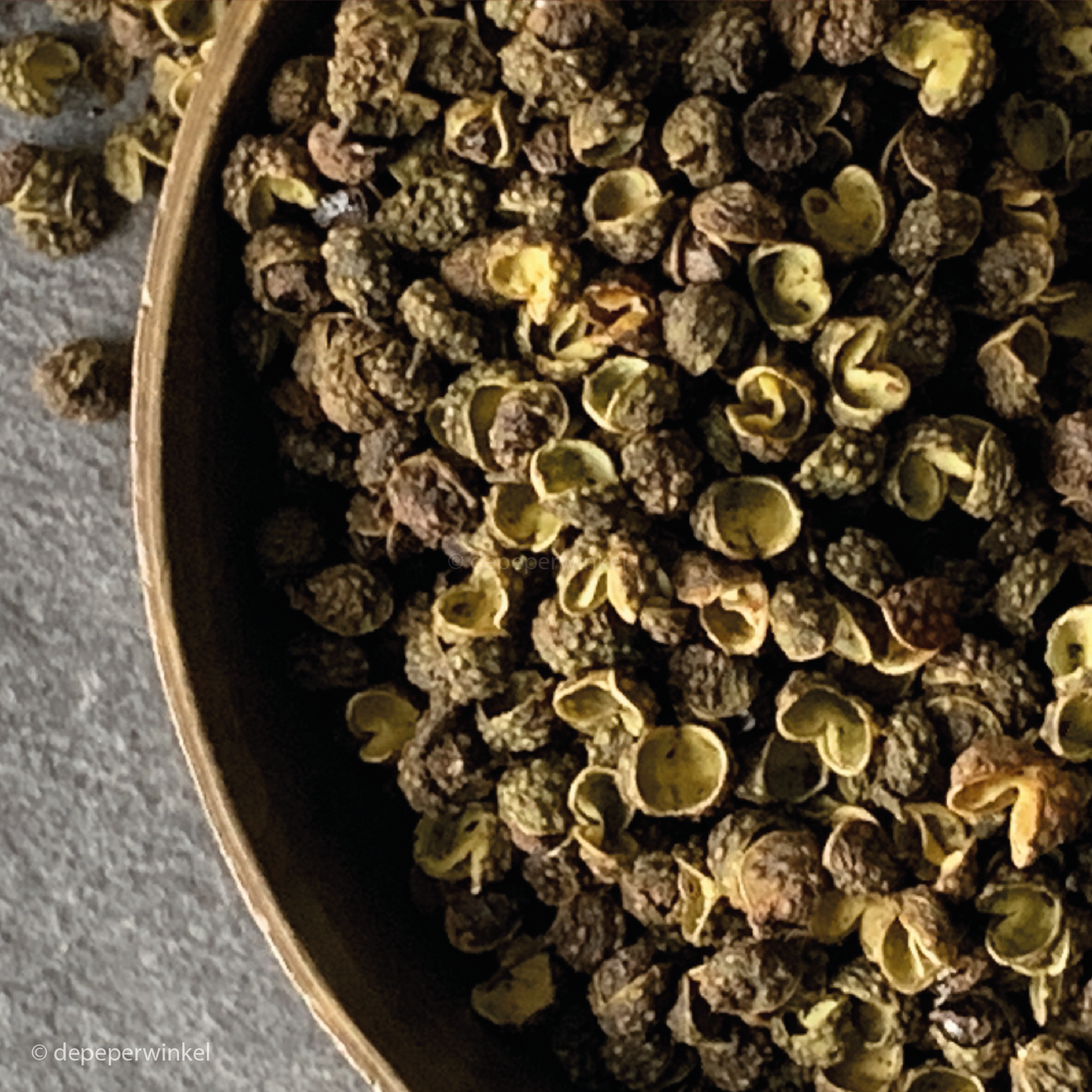
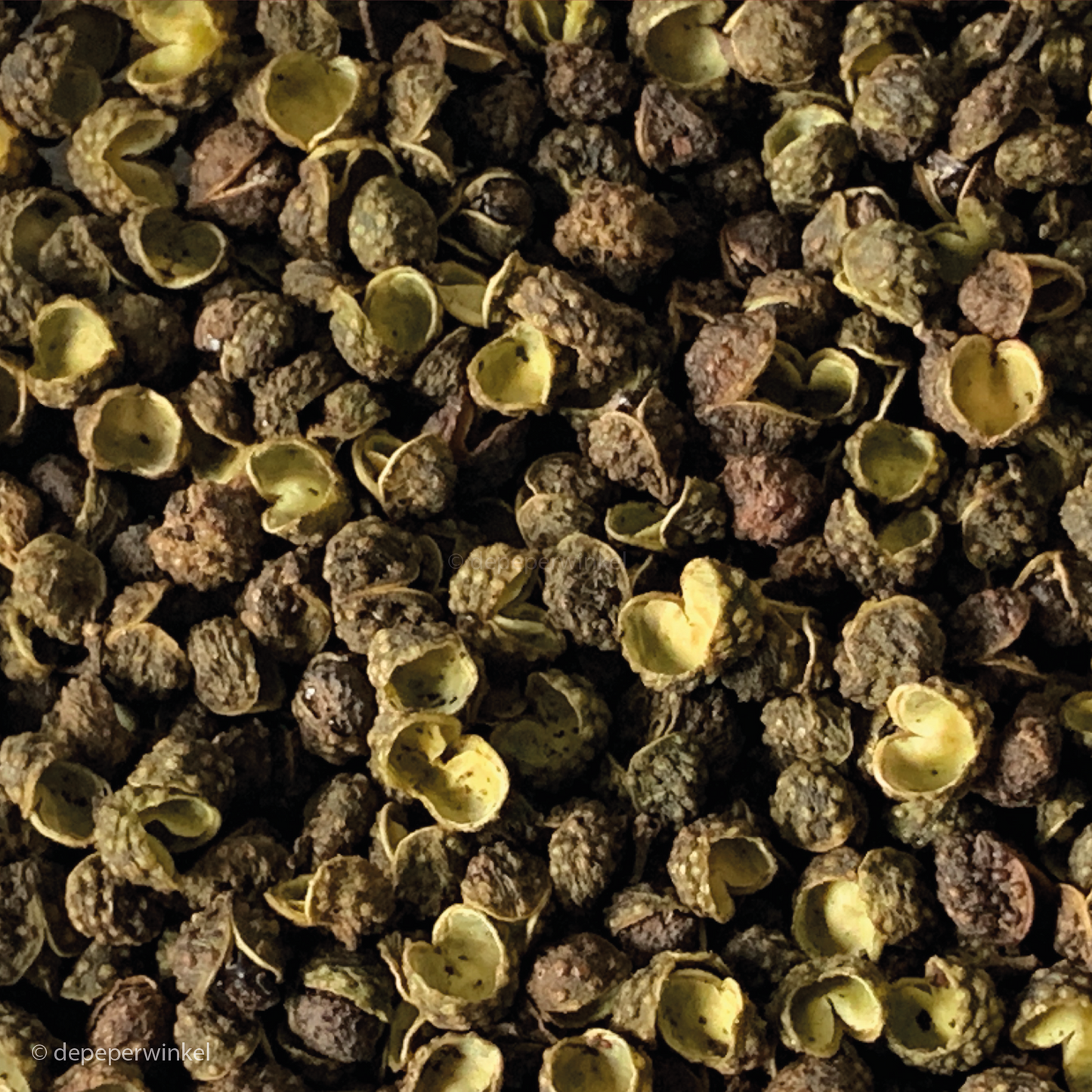
This green huā jiāo, fully known as Qīng huā jiāo, is a special Szechuan pepper. It is characterized by a fresh lemon aroma, which pairs well with fish, chicken, and vegetables. It is primarily used in hotpot and noodle dishes.
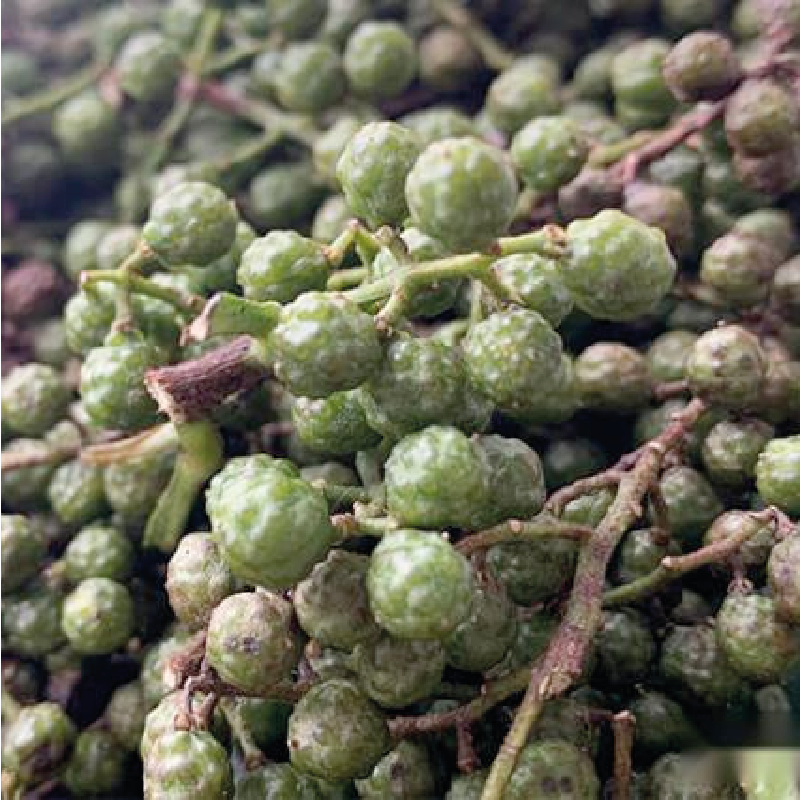
This Szechuan pepper is the dried, unripe berry of Zanthoxylum bungeanum, one of the many species of the toothache tree, called prickly ash in English because of the enormous thorns on the trunk and branches. The pepper is called Szechuan pepper after the region where it grows naturally, Szechuan, the home of one of the ten classic Chinese cuisines. The berry is larger than that of Zanthoxylum piperatum.
The Zanthoxylum is a plant that can grow into a large tree whose bark is covered with coarse, sometimes woody spines. As a result, the bark appears covered with a row of 'teeth', hence perhaps the Dutch name 'kiespijnboom' (toothache tree). In traditional Chinese medicine, the
The green berries are picked early in the autumn, well before the berries burst open and the rather bitter seeds are released. The berries are traditionally sun-dried. Better quality Szechuan pepper – like this one – contains no or hardly any seeds and no or hardly any stems, and is air-dried (conditioned -AD).
There is a distinct taste difference between the larger berry of Zanthoxylum bungeanum and the average smaller berry of Zanthoxylum piperitum, which makes the former very popular among Asian chefs. In the Chinese consumer market, but also in other Asian countries (and Europe), the small and often darker berry is the most sought after, partly due to the generally lower price. The 'old guard' in China also sticks to the taste of this widely available Szechuan pepper, but with a preference for the unripe, green variety.
The unique sharpness experience of sanshol
Characteristic of all Zanthoxylum
Szechuan is known as the spiciest Zanthoxylum pepper. In doing so, the Indonesian andaliman—a fairly rare variety—is conveniently forgotten, because this 'Batak pepper' is also quite spicy. Incidentally, ripe berries are spicier than unripe ones.
The tingling is accompanied by a mild numbing sensation, jokingly compared to tasting a 9-volt battery. A single berry is enough to experience this! This somatosensation, stimulation by touch, has been used for centuries as an anesthetic in traditional Asian medicine. Its mechanism of action is very complex and the subject of extensive studies. Hydroxy-α-sanshol, in particular, is believed to cause the tingling, and there are certain parallels with the sensation of spiciness from capsaicin, the pungent substance in chili peppers, but also with menthol and mustard oil.
Scent and taste
The Szechuan berry contains 83 volatile oils, of which the flavor-determining ones are:
- linalyl acetate, responsible for a pleasant citrus, bergamot, and lavender scent,
- limonene, the scent of lemon peel,
- linalol, responsible for the scents of rosewood and lavender
- geraniol, rose scent,
- geranyl acetate, lavender scent.
- β-pinene, pine resin, and
- 1.8 cineole or eucalyptol, camphoraceous
A ripe berry contains significantly more linalol, geraniol, and geranyl acetate—the rose components—than a green berry.
Combinations
Szechuan pepper pairs excellently with citrus (kaffir lime leaves), lemongrass, coconut, coriander leaves, curry leaves, exotic fruit, poultry, crustaceans, and shellfish.
Usage
Szechuan pepper holds a prominent place in classic and modern Szechuan cuisine. It is used in virtually every dish, whole or crushed, roasted and/or ground. In Szechuan cuisine, it is very common to roast Szechuan pepper before grinding it. The roasting is intended to 'play' with the aromas.
You see, something peculiar happens with Szechuan pepper.
The preparation temperature determines the flavor profile of Szechuan pepper. To bring out the aromas of 1,8-cineol (mint and sweet), linalool (floral and lavender), 2-phenylethanol (honey, spices, rose, and lilac), 4-methylacetophenone (bitter almond), and transcarveol (caraway), a temperature above 70 degrees is required. At low temperatures (below 40 degrees), aromas such as myrcene (balsamic), limonene (citric), and hexanal (grassy) will predominate. The same spice, a different taste effect.
Szechuan pepper is one of the ingredients of five-spice powder (wǔxiāng fěn). Not in our assortment.
For those unfamiliar with Szechuan pepper, it is advisable to start with caution and not to eat the pepper raw, unlike the Nepalese timur and the Vietnamese and Laotian varieties. mountain
Features:
- 100% berries of the Zanthoxylum bungeanum - opening rate 90% (seed poor)
- origin: Hunan
Assortment
- available in glass (30 grams), stand-up pouch (various weight classes) and test tube (10 ml)
- larger quantities than shown on request
Save
- batch number *HU570388
- best before September 2028 (09-2028)
General advice
- qīng huā jiāo is the Szechuan pepper par excellence in stir-fries and hot pots.
- Use this Szechuan pepper sparingly, and choose for yourself whether to use the berries whole or ground.
- Allow the berries to absorb plenty of moisture so that the flavor and sharpness are optimally utilized, and play with the heat (see above).
Expiration date - storage advice
Expiration date - storage advice
The stated expiration date is an indication of the shelf life. Because many factors can influence the maintenance of the quality of a spice, you may have to take it sooner or enjoy it for a long time. Trust your senses of smell and taste.
Store spices in a closed container, preferably in a dark, dry and cool place
The batch number that we mention with each product helps us to trace from which supply an item comes.
Dimensions
Dimensions
Onze ziplock-zakken zijn gemaakt van plastics, zo mogelijk van één soort plastic. Biedt ze aan bij het plastic-afval. De potjes zijn een levenlang te gebruiken om uw specerijen of spulletjes in te bewaren. Doet u het glas toch weg, doe het dan in de glasbak.
Allergen information
Allergen information
This product contains no allergens.
Our packaging
Our packaging
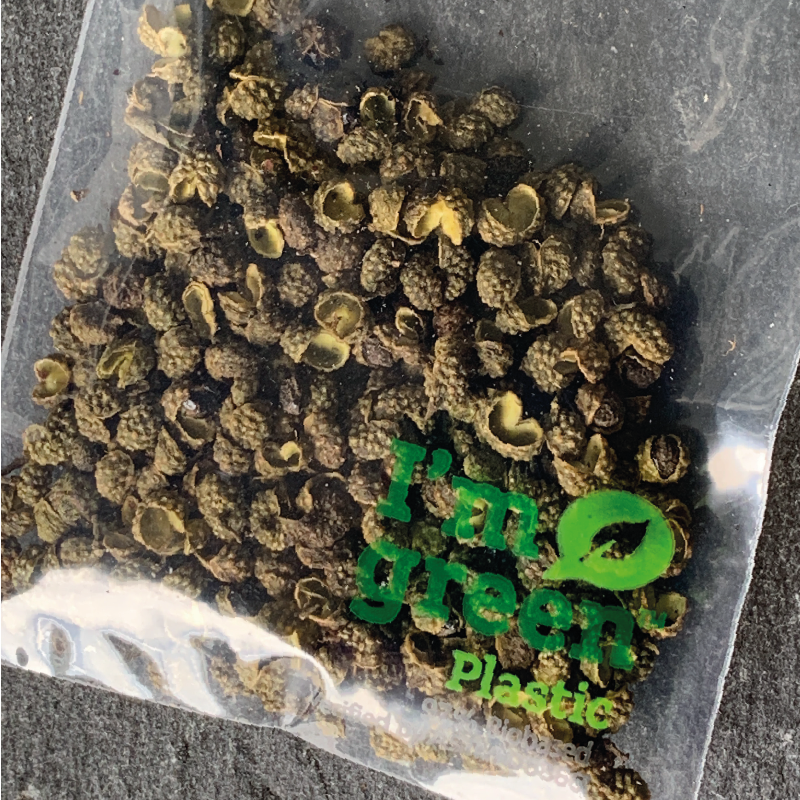
We supply this product in a practical twist-off jar (clear glass) of 128ml and in bags. For smaller quantities we use laminated stand-up pouches with ziplock closure, made of PET and PE. The bag is approximately 90% recyclable and is collected with the plastic.
Our two-layer bio-based kraft bags consist of a layer of 60 gram kraft paper and 80 micron PLA plastic. This bag is 100% biodegradable and can be placed in the green bin.
We use our aluminum bags for packaging larger quantities. These three-layer bags are made of laminated 12 micron PET, 7 micron aluminum and 60 micron PE. This combination makes it not possible to fully recycle the bags. These bags must be presented with the other waste.
The test tubes are made of PS plastic, have a diameter of 16 millimeters and a length of 100 millimeters. The caps are made of LDPE.
Share