depeperwinkel
Coriander seed
Coriander seed
In stock
Unable to load availability for pickup
These dried coriander seeds come from Italy, a country with an ancient coriander tradition, although you will hardly find the 'seeds' in traditional Italian cuisine.
There are two species of coriander, wild coriander (Coriandrum tordylium) and domesticated coriander (Coriandrum savitum). They resemble each other in many respects. Actually, nothing is known about their domestication—neither where nor how.
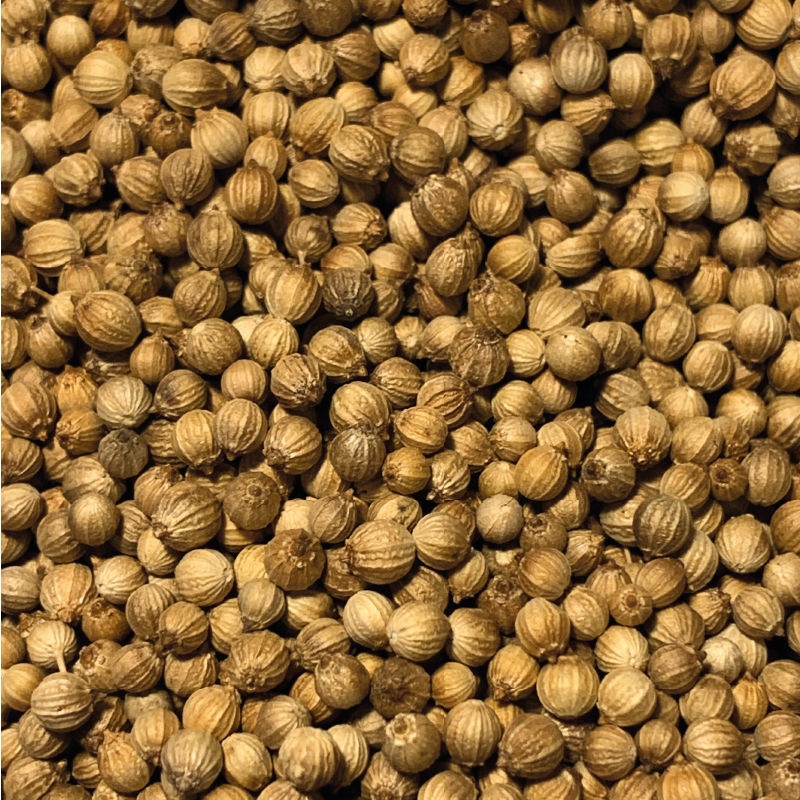
The small fruits of the coriander are round, sometimes oval, and recognizable by the longitudinal ribs: strongly pronounced primary ribs and less visible, wavy secondary ribs. In common usage, the small fruits are called seeds, coriander seed, although that is actually incorrect.
The fruits are in the order of 3 to 5 mm in size and have a citrusy flavor due to the terpenes linalool and pinene, which is also described as nutty or spicy. There is a correlation between the size of the fruits and the taste. The larger fruits often come from plants with only a few leaves, such as Moroccan coriander.
Scent and taste
The essential oil content of coriander seeds depends on the variety used and the freshness of the seeds, and can range from 20 to 28%. Around 70% of the oil is petroselic acid, which is also found in parsley seeds (78%) and celery seeds (64%). Additionally, coriander oil consists of 14% linoleic acid (C18:2) and 6% oleic acid (C18:1n-9).
The main flavor components of coriander seed are:
- linalol
- gamma-terpinene, sweet-spicy, citrus notes, as in caraway and eucalyptus,
- camphor
- alpha- and beta-pinene, woody pine scent, as in cumin, pine (pinecone), juniper and hemp,
- geraniol, rose scent, as in nutmeg, basil and siltimur, and
- geranyl acetate, responsible for the rose and lavender scent.
Usage
The fruits of the coriander are not edible. They are too hard and fibrous to be eaten—even after cooking. Therefore, they are removed from the dish after cooking, or ground or crushed beforehand. The seeds are preferably roasted to bring out the flavor more.
Coriander seed—the same applies to coriander powder—will not easily overpower other flavors, unlike the leaves. Some perceive buttery aromas in it. Overall, coriander seed tastes warm, sweet, and earthy, with notes of citrus (lemon peel) and the scent of flowers, such as cardamom.
Coriander seed is used in numerous dishes, often in combination with cumin. Examples of dishes with coriander seed include curries, pickled vegetables, soups, and stews. It is an ingredient in many spice blends in Indian and Indonesian cuisine, but the use of coriander seed is certainly not limited to Asian cuisines; it is also used in French cuisine, for example in ratatouille.
Features:
- 100% dried fruit pieces - average 3 mm - of the Coriandrum sativum
- origin: Italy
Assortment
- available in glass (45 grams) and stand-up pouch (various weight classes)
- larger quantities than shown on request
Save
- batch number **220339
- best before November 2027 (11-2027)
Expiration date - storage advice
Expiration date - storage advice
The stated expiration date is an indication of the shelf life. Because many factors can influence the maintenance of the quality of a spice, you may have to take it sooner or enjoy it for a long time. Trust your senses of smell and taste.
Store spices in a closed container, preferably in a dark, dry and cool place
The batch number that we mention with each product helps us to trace from which supply an item comes.
Dimensions
Dimensions
Onze ziplock-zakken zijn gemaakt van plastics, zo mogelijk van één soort plastic. Biedt ze aan bij het plastic-afval. De potjes zijn een levenlang te gebruiken om uw specerijen of spulletjes in te bewaren. Doet u het glas toch weg, doe het dan in de glasbak.
Allergen information
Allergen information
This product contains no allergens.
Our packaging
Our packaging
We supply this product in a practical twist-off jar (clear glass) of 128ml and in bags. For smaller quantities we use laminated stand-up pouches with ziplock closure, made of PET and PE. The bag is approximately 90% recyclable and is collected with the plastic.
Our two-layer bio-based kraft bags consist of a layer of 60 gram kraft paper and 80 micron PLA plastic. This bag is 100% biodegradable and can be placed in the green bin.
We use our aluminum bags for packaging larger quantities. These three-layer bags are made of laminated 12 micron PET, 7 micron aluminum and 60 micron PE. This combination makes it not possible to fully recycle the bags. These bags must be presented with the other waste.
The test tubes are made of PS plastic, have a diameter of 16 millimeters and a length of 100 millimeters. The caps are made of LDPE.
Share