Etnia -depeperwinkel
Merkén (merquén)
Merkén (merquén)
In stock
Unable to load availability for pickup
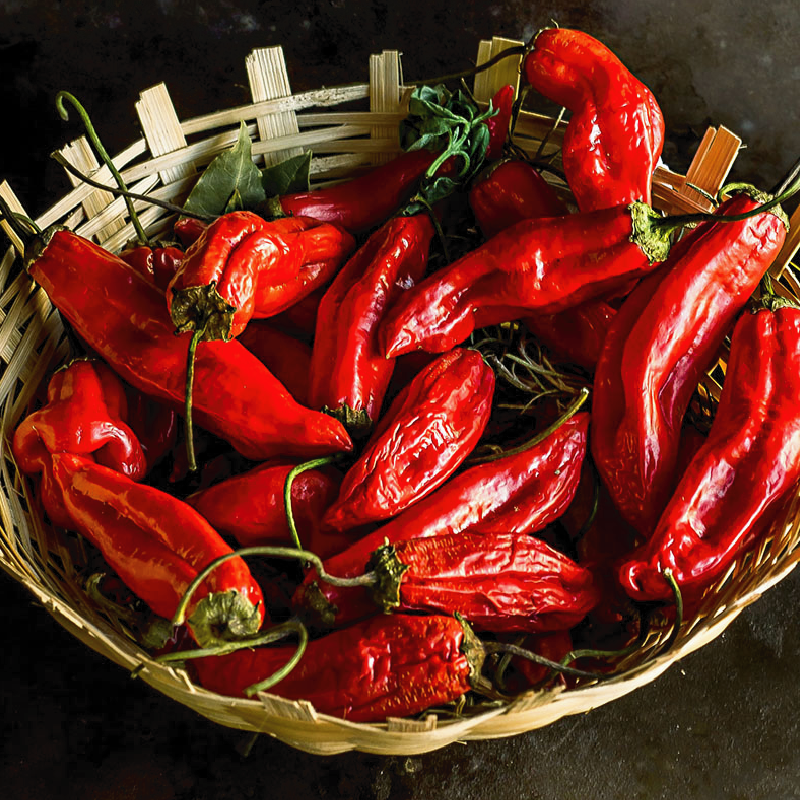
MErkén, or merquén in Spanish, is a blend based on the ground smoked Ají cacho de cabra, the goat horn chili. It is a specialty of the Mapuches, an indigenous Chilean people, who call this chili caciocavra.
Available in original kraft bag (100 grams) or packed by us in a jar or glass, in various quantities.
The Slow Food Foundation supports the cultivation of this caciocavra chili and the coriander that is inextricably linked to the merquén blend as it has traditionally been made in Nagche and Wenteche in the Araucanía, an area in southern Chile where many Mapuches live.
In February, the still-green goat horn chilies are harvested when they are on the verge of turning red. By drying them in the sun, the chilies initially turn violet. Now it is time to smoke the chilies. They are smoked for no more than half an hour over a fire of eucalyptus wood. After this, the chilies are laid out to dry in the sun a second time before being ground. This is actually already a finished product, comparable to Spanish pimentons, but a semi-finished product for the manufacture of merkén. In the past, merkén contained exclusively chili.pepper.
The ají cacho de cabra is a nearly two-thousand-year-old Capsicum annuum species, classified as a Chilean-Peruvian landrace. It was already cultivated during the Moche civilization in northwestern Peru, nowadays mainly in the Maule region, La Araucania, and in Peru in the valleys of the provinces of Chiclayo and Lambayequem.
The Mochica were farmers who lived from 100 to 750 AD in northern Peru, in various valleys along the coast. Their territory was four hundred kilometers long and extended eighty kilometers inland. They used advanced irrigation systems to cultivate their crops. They even owed their prosperity to them. The civilization came to an end after a period of heavy rainfall, followed by three decades of prolonged drought (El Niño).
Merquén is a very special blend. It is the ancestor of all chili powders. Merquén embodies the way the Mapuches stood their ground against the European conquerors of the sixteenth and seventeenth centuries by making tactical use of European skills and applying them to integrate into their own culture. For example, coriander came to their culture, which originated solely from Chile.pepper manufactured brands.
Merkén symbolizes the steadfastness of the Mapuches and, incidentally, has only recently begun to attract the attention of chefs around the world interested in 'forgotten' products. For that is what it is: until 2000, the outside world was unfamiliar with the product. Our Merquén is made according to a traditional Mapuche recipe using ingredients sourced from various parts of Chile. It is made from this specific chili, roasted coriander, and some salt.
Much merquén outside Peru is made with locally grown chilies, generally not goat horn chilies.
Work is underway to protect the species name. In that light, inclusion in the Slow Food Foundation's Ark of Taste is a necessary first step.
Usage
Cacho de cabra is one of the most important chilies in Mapuche cuisine, and has found its way from that tradition into modern Chilean cuisine.
It is often dried and ground for use in marinades and dishes such as chili con carne and in soup. After hydration, the pepper used in sauces and pastas. The best-known application is in merquén, to which the pepper owes the nickname ají merkén.
Traditionally, the Mapuches use merquén in mashed potatoes (puré picante)—the Mapuche region is the origin of a large number of potato cultivars—and around peanuts (mani merkén).But also in traditional Chilean dishes such as lomito (a sandwich with marinated pork), chacarero (ditto, but with thinly sliced beef), on pizzas, and in pebre, the famous Chilean sauce. However, merkén also pairs excellently with fish (salmon) and pumpkin – as well as the warm mashriq blend. baharat.
In the Araucanía region grows the Araucanía, a tree known for its seeds, piñónes (pine nuts). A typical Mapuche dish is sautéed piñónes with merkén: the nuts are boiled and then fried with garlic, oregano, and salt. Merkén is used as the finishing touch.
And what about a coffee-rubbed steak? For this, make a rub of 2-3 parts ground robust coffee, 1 part brown sugar, 1 part to notice and salt and garlic to taste (max 1 part)? If you make the rub in advance and want to save it for future use, do not use fresh garlic, but garlic powder.
Features
- mixture of goat horn pepper (Capsicum annuum), roasted coriander seeds, salt
- We only supply the original brands, originating from Chile from the brand Etnia (Mapuche).
- no preservatives
Assortment
- in original Etnia packaging - 100 grams
- In addition, the original Etnia Merkén is available in our own packaging, in glass (45 grams) and/or stand-up pouch.
- stable prices since: 10-08-2024
General advice
- Store the merquén in a cool place and certainly not in direct sunlight;
- After opening, the ground product has a shelf life of at least three months, provided it is kept in a closed package.
- If you want to keep your merkén for a long(er) time: store your merkén in the refrigerator between 3 and 5°C, just like piment d'Espelette.
Best before:
- batch no. DW590408 - September 2028
- batch no. **348 - December 2027
- These expiration dates are an indication.
Expiration date - storage advice
Expiration date - storage advice
The stated expiration date is an indication of the shelf life. Because many factors can influence the maintenance of the quality of a spice, you may have to take it sooner or enjoy it for a long time. Trust your senses of smell and taste.
Store spices in a closed container, preferably in a dark, dry and cool place
The batch number that we mention with each product helps us to trace from which supply an item comes.
Dimensions
Dimensions
Onze ziplock-zakken zijn gemaakt van plastics, zo mogelijk van één soort plastic. Biedt ze aan bij het plastic-afval. De potjes zijn een levenlang te gebruiken om uw specerijen of spulletjes in te bewaren. Doet u het glas toch weg, doe het dan in de glasbak.
Allergen information
Allergen information
This product contains no allergens.
Our packaging
Our packaging
We supply this product in a practical twist-off jar (clear glass) of 128ml and in bags. For smaller quantities we use laminated stand-up pouches with ziplock closure, made of PET and PE. The bag is approximately 90% recyclable and is collected with the plastic.
Our two-layer bio-based kraft bags consist of a layer of 60 gram kraft paper and 80 micron PLA plastic. This bag is 100% biodegradable and can be placed in the green bin.
We use our aluminum bags for packaging larger quantities. These three-layer bags are made of laminated 12 micron PET, 7 micron aluminum and 60 micron PE. This combination makes it not possible to fully recycle the bags. These bags must be presented with the other waste.
The test tubes are made of PS plastic, have a diameter of 16 millimeters and a length of 100 millimeters. The caps are made of LDPE.
Share