depeperwinkel
Nutmeg 80/85
Nutmeg 80/85
In stock
Unable to load availability for pickup
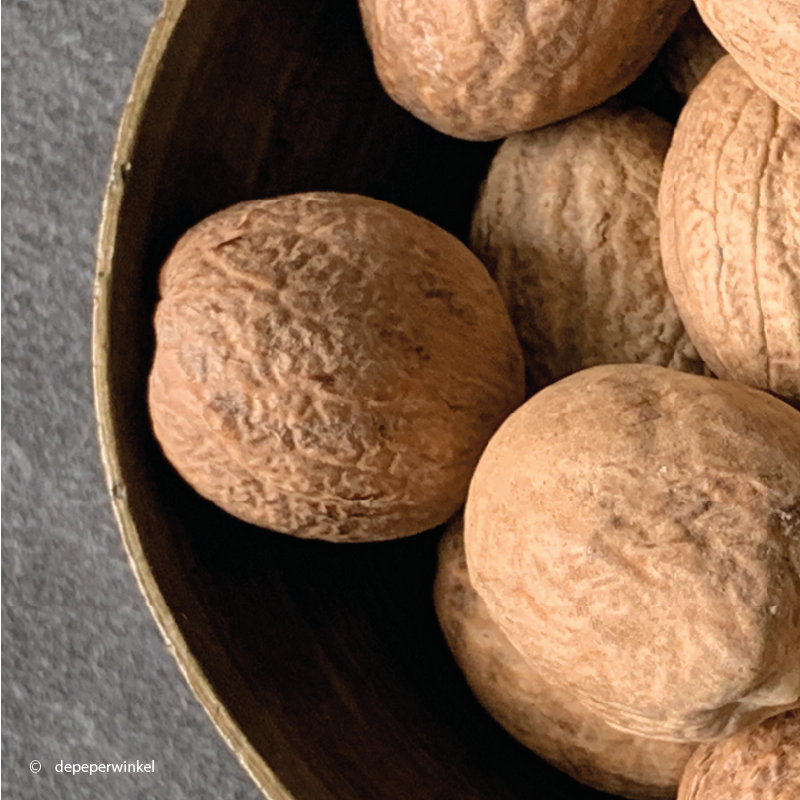
We call the hulled seeds of the nutmeg tree nutmeg. or nutmeg. Just like the seed coat (mace), they are very aromatic. Our nutmeg is organically grown. These larger seeds come from Sri Lanka. We also have smaller seeds from India in our assortment.
The nutmeg tree is an evergreen tree native to the Moluccas, where it is called pala. But what exactly is nutmeg?
We know it as a 'nut', but in fact it is a kernel, the inner part of the seed, stripped of its hard shell. Elsewhere you can buy nutmeg shell and all, but in our country nutmeg is available almost exclusively without the shell. Not only this part, but also the seed coat and the flesh are edible. The membrane is considered a separate spice, and we call it mace.
The nutmeg, to use that word once again, is oval. -elliptoid - in shape and about one and a half centimeters long. The outside is ribbed, a pattern that is also seen recurring on the inside. Our nutmeg is a selection consisting of nuts weighing between 6 and 6.5 grams each.
The word nutmeg is a corruption of the Latin "nuces moschatae", which means 'nuts smelling of musk'. These are the principal essential oils, those marked with an arterisk * are the principal flavor and aroma determinants of this warm, fragrant spice:
- α- and β-pinene, woody pine scent, as in cumin, pine (pine cone), juniper and hemp,
- elemicin *, hallucinogenic, pungent-smelling substance in nutmeg,
- limonene, the scent of lemon peel,
- methyl eugenol *, a floral aroma (mimosa),
- myristicin *, warm spicy, like balsamic vinegar, in cinnamon, nutmeg, black pepper, Assam pepper and parsley
- sabinene, responsible for the woody, camphor-like flavor of black pepper, among others, with citrus and pinecone notes, and
- safrole *, the smell of a candy store, o.a. present in cinnamon and nutmeg.
Is this nutmeg organic?
In order to supply this organically grown nutmeg under the organic label, we, as the packer/producer of the spice, would need to be certified. That is simply the way it is. We are not. Although we process and store organic products and products from conventional cultivation strictly separately, we are not allowed to use the organic label.
Scent and taste
Nutmeg has a scent and aroma that is often referred to in relation to other herbs and spices because it is so characteristic of nutmeg. Its aromatic palette combines excellently with products that carry the same ethereal building blocks, including cinnamon, cloves, cardamom, ginger root, dill, sage, thyme, and parsley; vegetables such as cabbage, carrots (cavalo nero, cauliflower), pumpkin, and spinach; potatoes and onions; lamb, chicken; sharp-tasting cheeses like Gruyère (think of cheese fondue), but also cream cheese or ricotta salata; and fruits such as pear and banana. And, of course, in béchamel sauce.
Usage
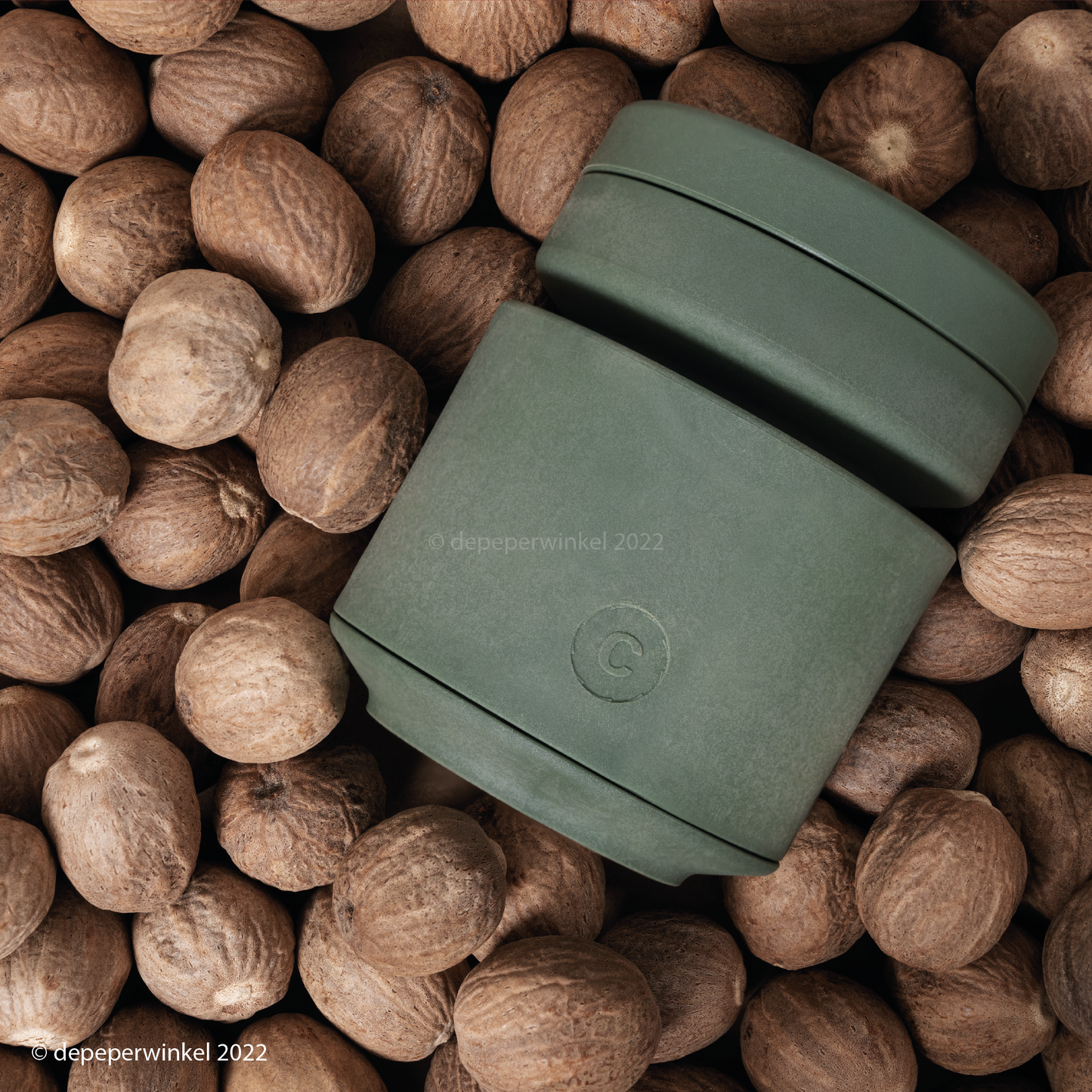
To grind nutmeg, you need tools such as a grater, a plane, or a mortar and pestle. Not every nutmeg mill is equally convenient, which is why many people fall back on the good old grater. We sell the Crushgrind nutmeg mill from the Billund series, with which you can grate any hard spice, not just nutmeg.
Nutmeg is severely underestimated in Western European cuisine. Cookbooks stammer a bit about green beans and cauliflower, but that is usually as far as it goes. In Indonesian cuisine, nutmeg is naturally indispensable, and the same goes for Indian cuisine.
The history in a nutshell
In the Middle Ages, the nutmeg trade was in the hands of Arabs, who supplied Europe with what was then called note muscate, a popular but expensive spice and medicine of the time. In the seventh century, the demand for this medicine was enormous. It was used against the plague, a pandemic that claimed the lives of 75 million (!) people worldwide.
The Arabs kept the site of the find jealously secret and saw the price skyrocket.
The Arab monopoly was broken when Vasco de Gama discovered the island group where nutmeg grew: the Banda Islands in the Pacific Ocean. In the seventeenth century, these islands came into the hands of the Dutch East India Company, which stopped at nothing to secure the monopoly. To this end, in 1621, Governor-General Jan Pieterszoon Coen proceeded to the violent 'extirpation' of the Banda Islands, under the pretext that the population continued to sell nutmeg to the Portuguese and the British in defiance of the VOC's ban.
Coen ordered his troops to massacre the population. Additionally, all nutmeg trees were cut down, except those on the island of Banda Neira. There, he reorganized production by dividing the largely depopulated island into parcels and leasing them out to so-called 'perkeniers'. These were permitted to supply exclusively the Company. The 'perken', as the parcels were called, were maintained by 'perkhorigen', slaves originating from all parts of Asia.
The British succeeded in breaking the Dutch state's monopoly in the early nineteenth century. The VOC had been nationalized shortly before, in 1796. The British presence was short-lived, however, as the Dutch soon regained control of Banda. During that brief period, the British secured the planting material and introduced cultivation to Grenada, Pendang, Ceylon (Sri Lanka), India, and Zanzibar.
Zanzibar was not the first island off the East African coast where nutmeg was cultivated. As early as the seventeenth century, the French botanist Jean Poivre succeeded in obtaining fertile seed under the VOC monopoly and planting it on the Île de France, as Mauritius was then called.
Africa has various indigenous alternatives to nutmeg, such as the West African ehuru, pèbè, or calabash nutmeg (Monodora myristica). The taste resembles that of 'true' nutmeg, but the nut is pepperier and is therefore sometimes labeled as 'pepper'. Unfortunately, the domestic market for this particularly unique 'nutmeg' is shrinking due to the rise of 'true nutmeg'. In Madagascar, for example, several false nutmegs grow naturally, such as the Rarabee, the Bashi-bashi, and the Rhanha-horac.
The Banda Islands have always remained an important production area, but nowadays most nutmeg comes from India, especially from Tamil Nadu. However, most of the nutmeg entering the Netherlands comes from Indonesia (86%). In our country, most nutmeg is imported from Indonesia and Sri Lanka. Our nutmeg farmers, united in a cooperative, cultivate the nutmeg organically.
This nutmeg 80/85 contains 80-85 seeds per pound (453 g). The piece weight is 5 to 7 grams.
Features:
- 100% dried seeds of Myristica fragrans
- not powdered!
- origin: Sri Lanka
Assortment
- available in glass (45 grams - 7-8 pieces) and stand-up pouch (no test tubes)
- Larger quantities on request
Gift packaging
- The jar is available in tasteful gift packaging, consisting of a cube box filled with black tissue paper.
- For an overview of our gift packaging, please refer to the gift packaging section.
Health aspects
Raw nutmeg, including freshly ground nutmeg, contains high levels of myristicin and elemicin, which are hallucinogenic substances. When used as a spice, you do not notice this, but in higher doses, you do. This is the basis for the popularity of the Indonesian nutmeg cigarette, the kretek, which also contains cloves. In normal use, nutmeg is harmless. An overdose is defined as eating one or more whole nuts per day.
General advice
- Grind nutmeg just before using it in a dish; once ground, it loses its aromas quite quickly.
Save:
- Store your nutmeg in a closed package, an opened nut for example in the storage compartment of the nutmeg grinder.
- preferably store in a dark, dry and cool place
- best before August 2028 (08-2028)
Expiration date - storage advice
Expiration date - storage advice
The stated expiration date is an indication of the shelf life. Because many factors can influence the maintenance of the quality of a spice, you may have to take it sooner or enjoy it for a long time. Trust your senses of smell and taste.
Store spices in a closed container, preferably in a dark, dry and cool place
The batch number that we mention with each product helps us to trace from which supply an item comes.
Dimensions
Dimensions
Onze ziplock-zakken zijn gemaakt van plastics, zo mogelijk van één soort plastic. Biedt ze aan bij het plastic-afval. De potjes zijn een levenlang te gebruiken om uw specerijen of spulletjes in te bewaren. Doet u het glas toch weg, doe het dan in de glasbak.
Allergen information
Allergen information
This product contains no allergens.
Our packaging
Our packaging
We supply this product in a practical twist-off jar (clear glass) of 128ml and in bags. For smaller quantities we use laminated stand-up pouches with ziplock closure, made of PET and PE. The bag is approximately 90% recyclable and is collected with the plastic.
Our two-layer bio-based kraft bags consist of a layer of 60 gram kraft paper and 80 micron PLA plastic. This bag is 100% biodegradable and can be placed in the green bin.
We use our aluminum bags for packaging larger quantities. These three-layer bags are made of laminated 12 micron PET, 7 micron aluminum and 60 micron PE. This combination makes it not possible to fully recycle the bags. These bags must be presented with the other waste.
The test tubes are made of PS plastic, have a diameter of 16 millimeters and a length of 100 millimeters. The caps are made of LDPE.
Share